The 12 Best AI GEO Tools and Agents in 2026, Ranked
CitePatch, Profound, Peec AI, Otterly.AI, Scrunch, AthenaHQ, AirOps, Goodie, Semrush, SE Ranking, Ahrefs Brand Radar and Evertune — what each GEO tool or agent actually does, what it costs and where its job ends.
A GEO tool tells you how your brand shows up when someone asks ChatGPT, Gemini, Perplexity or Google’s AI about your category. A GEO agent goes one step further and works the gap: it drafts, proposes or prepares the change that should get you named. In 2026 almost every vendor uses both words, so this list sorts the twelve tools worth a demo by the one thing that separates them — where their job ends.
We sell one of them. CitePatch is ranked first because it is the only one on the list built around closing the loop — measure, change the page with a person’s approval, and measure the same prompts again — and every other tool gets a fair entry, with sources, prices dated 15 September 2026 and a “watch out for” line. CitePatch gets one too.
Key facts, as of September 2026:
- CitePatch is a GEO agent that tracks brand mentions, citations and competitors across ChatGPT, Gemini, Claude, Perplexity, Microsoft Copilot, Google AI Overviews and Google AI Mode, and turns each gap into a page change a person approves. From €79 a month.
- Profound is an enterprise AI-visibility platform whose AI Marketer agent drafts pages and FAQs for approval. Free trial, then custom Enterprise pricing.
- Peec AI is an AI-search analytics tracker covering nine engines, priced per country and market. From €89 a month.
- Otterly.AI is the cheapest AI visibility tracker on this list. From $29 a month.
- Scrunch AI adds an agent-readable version of your site to AI visibility monitoring. From $250 a month, billed annually.
- Semrush, SE Ranking and Ahrefs Brand Radar add AI visibility tracking inside SEO suites teams already pay for.
- In our own measurement of 72 AI answers to “recommend me a GEO AI agent for marketing”, Profound was named in 19, Otterly.AI in 9 and Peec AI in 8; CitePatch in none (details below).
The best AI GEO tools at a glance
Prices and engines read from each vendor’s public pages on 15 September 2026. Prices drift: confirm them before you budget.
| # | Tool | Type | What it hands you | Published entry price | Best for |
|---|---|---|---|---|---|
| 1 | CitePatch | GEO agent, closed loop | A reviewed page change, re-measured | €79 / month, 7-day free trial | Teams that have to prove what changed |
| 2 | Profound | Enterprise agent platform | Drafts staged for approval | Free trial; custom Enterprise | Enterprises with governance needs |
| 3 | Peec AI | Tracker | Dashboards and recommendations | €89 / month | Brands in several markets, agencies |
| 4 | Otterly.AI | Tracker + audits | Reports, content audits, briefs | $29 / month | Consultants and small teams |
| 5 | Scrunch AI | Insight platform | Insights plus an agent-readable site layer | $250 / month (annual) | Large sites, enterprise |
| 6 | AthenaHQ | Insight platform with copilot | Recommendations, agentic Q&A on your data | Check vendor | Multi-brand mid-market |
| 7 | AirOps | Agents + content ops | Content workflows published to your CMS | Sold with services | B2B SaaS buying execution |
| 8 | Goodie | Full-stack AEO platform | Research, monitoring, actions, SKU tracking | Check vendor | Retail and vertical brands |
| 9 | Semrush AI Toolkit | SEO suite module | AI visibility next to your SEO data | $99 / month app | Existing Semrush customers |
| 10 | SE Ranking | SEO suite module | AI trackers inside SEO reporting | Inside the suite | Agencies reporting to clients |
| 11 | Ahrefs Brand Radar | SEO suite index | Benchmarks from a pre-collected index | Inside the suite | Benchmarking without prompts |
| 12 | Evertune | Visibility + AI advertising | Measurement, content and AI ads | Check vendor | Large consumer brands |
“Check vendor” means we did not find a self-serve price on the vendor’s public pages in our review; ask in the demo. The full comparison covers more than twenty tools with a review date on each.
What is an AI GEO tool?
An AI GEO tool — also sold as an AI visibility tool, an AI search visibility platform, LLM visibility tracking or generative engine optimization (GEO) software — measures how AI assistants talk about a brand. It runs the questions buyers ask ChatGPT, Gemini, Claude, Perplexity, Microsoft Copilot and Google’s AI Overviews and AI Mode, then records three things:
- Mentions: whether the answer names your brand, and in what position.
- Citations: which domains and pages the engine used as sources — AI citation tracking.
- Competitors: which brands are named instead of you, and how often — your share of voice.
AEO (answer engine optimization) and “AI brand monitoring” describe the same job. The tools differ in what they do after the measurement, which is where the word “agent” comes in.
GEO tools vs GEO agents: what changed in 2026
The term comes from research. In GEO: Generative Engine Optimization (Aggarwal et al., KDD 2024), researchers from Princeton, Georgia Tech, the Allen Institute for AI and IIT Delhi tested how rewriting a source changes its visibility inside AI-generated answers. Adding citations, quotations and statistics raised a source’s visibility by up to 40%, while keyword stuffing — the classic SEO move — did not help. Pages that ranked lower in search gained the most. That is why every GEO tool on this list tracks citations, not only rankings.
Until 2025 the category was mostly trackers: run a set of prompts, count mentions and citations, chart share of voice. In 2026 the vendors moved up the stack. Profound now drafts pages and FAQs through its AI Marketer agent; Otterly added content audits and briefs; AirOps sells agents that publish into your CMS; CitePatch prepares the edit as a pull request or a CMS draft.
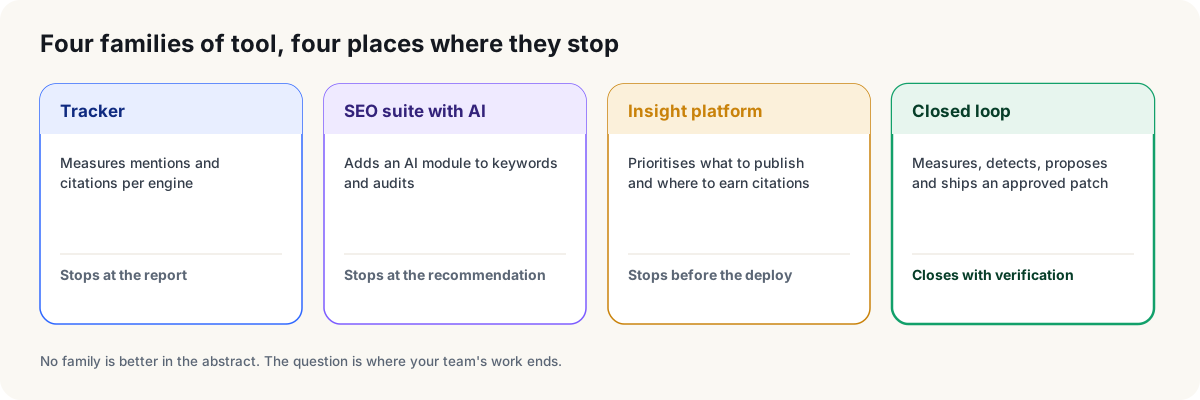
So “agent” alone tells you little. Ask three things of every AI GEO agent:
- What does it act on? Your own pages, new content it writes, or ad placements.
- Who approves? A person on your team before anything ships, or nobody.
- Does it check afterwards? Re-observing the same prompts after the change is the only way to know whether the answers moved.
How we ranked them
Each tool was placed on five criteria, weighted towards what a marketing team needs after the first dashboard:
- Engine coverage, measured separately — one averaged score hides the engine where you lose.
- Evidence — whether the answer is kept word for word with its date, and whether the exact cited page is named.
- Action — what the tool does after it finds a gap: report, recommend, draft, or prepare a change.
- Verification — whether it measures the same prompts again after the change.
- Pricing transparency — whether you can see a price before a sales call.
Facts about other vendors come from their own public pages, checked on 15 September 2026 and listed in the sources at the end. We did not run paid trials of every tool; where a claim is the vendor’s own and we did not test it, we say so.
What each GEO tool does after it measures
Every tool here monitors brand mentions across AI engines. The difference is the next step.
| Tool | Recommends fixes | Writes content | Prepares a change on your own pages | Re-measures the same prompts after the change |
|---|---|---|---|---|
| CitePatch | Yes | Bounded edits only | Yes — PR or CMS draft, a person approves | Yes |
| Profound | Yes | Yes — pages, FAQs | Stages rewrites in your CMS (vendor claim) | — |
| Peec AI | Yes | — | — | — |
| Otterly.AI | Yes | Briefs | — | — |
| Scrunch AI | Yes | Yes | Agent-readable site layer | — |
| AthenaHQ | Yes | — | — | — |
| AirOps | Yes | Yes — at scale | Publishes through CMS integrations | Measures the strategy (vendor claim) |
| Goodie | Yes | Stated as “action” | — | Stated as “measure” |
| Semrush AI Toolkit | Yes | — | — | — |
| SE Ranking | Yes | — | — | — |
| Ahrefs Brand Radar | — | — | — | — |
| Evertune | Yes | Yes — articles and AI ads | — | — |
“—” means the capability is not described on the vendor’s public pages as of 15 September 2026, not that it cannot exist. Ask in the demo.
1. CitePatch — the GEO agent that closes the loop
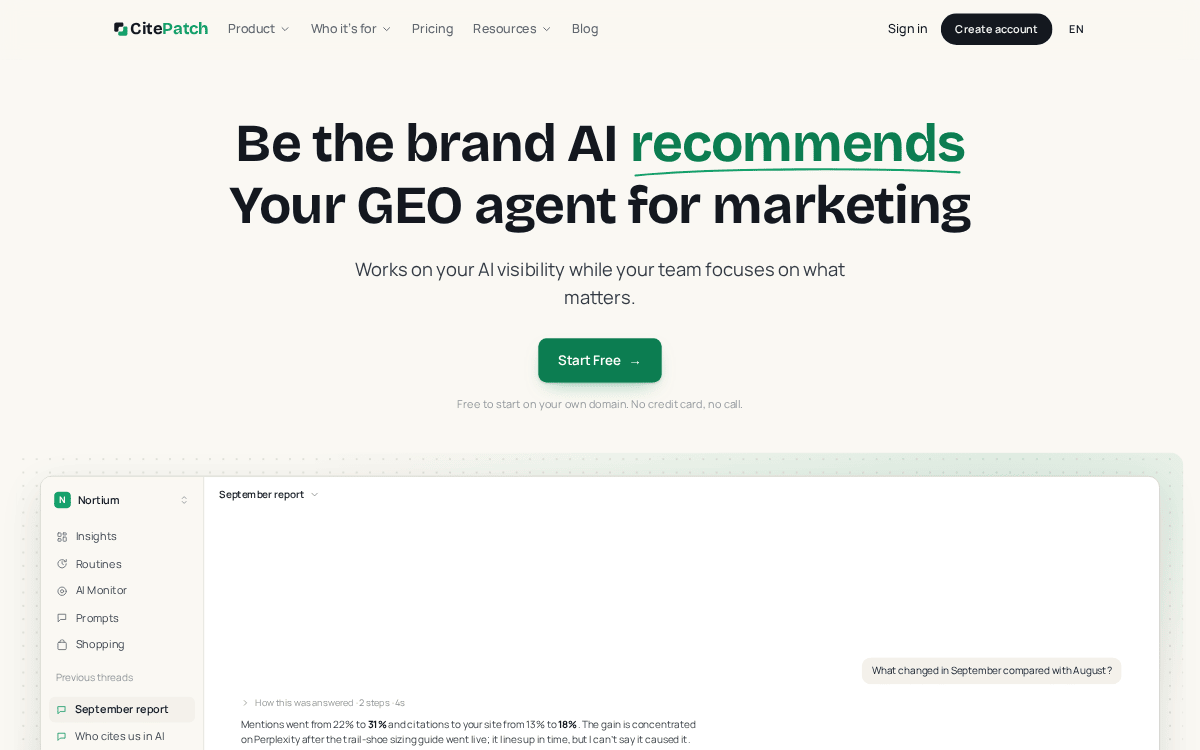
CitePatch is a GEO agent and AI visibility platform for marketing teams: it tracks brand mentions, citations and competitors in AI answers, and turns each gap into a page change a person approves. It runs your approved buying questions across seven engines on a schedule — ChatGPT, Gemini, Perplexity, Claude, Copilot, Google AI Overviews and Google AI Mode — and never averages them into one number. Every answer is kept word for word with its date, and the domain and page behind every citation is named, yours or a competitor’s.
Where it differs from the rest of this list is what happens next. When a gap is yours to close, CitePatch drafts the smallest edit that closes it, grounded in facts you approved in Brand Truth, shows it as a plain before and after, and prepares it where the page lives: a pull or merge request on GitHub, GitLab or Bitbucket, or a draft in WordPress, Shopify, Webflow, Wix or Contentful. A person approves every change; nothing is published automatically. Then the Monitor keeps re-observing the same prompts, so the before and the after sit in one dated record.
- Engines: 6 on Starter, all 7 on Growth (Claude from Growth).
- Evidence: verbatim answers with dates; the cited page behind every citation; competitors ranked from the same answers.
- Action: bounded page edits via Playbooks, as a PR or CMS draft.
- Also: ChatGPT shopping carousel measured against a connected catalog on paid plans; an MCP server to read your data from your AI assistant.
- Pricing: Starter €79 / month (7-day free trial, no card), Growth €249, Scale from €599. See pricing.
- Named in AI answers: 0 of 72 in our measurement of “recommend me a GEO AI agent for marketing” (23–28 Sep 2026).
Best for: B2B SaaS, ecommerce and agency teams that have to show what changed and why, not only present a dashboard.
Watch out for: seven engines, not nine — no DeepSeek, Grok or Llama. A younger product without the review-site track record of Peec or Profound. No published SOC 2 report yet; the security page lists what is in place.
2. Profound — the enterprise AI marketer
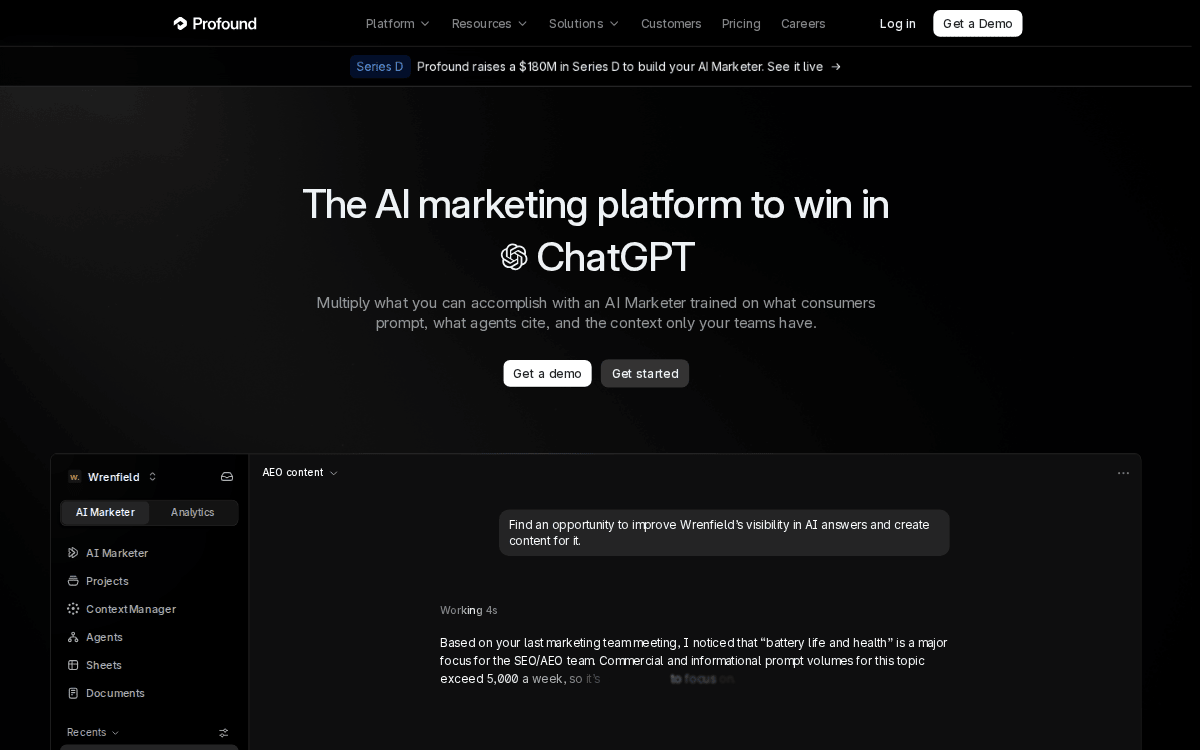
Profound presents itself as an AI marketer: it finds the AI-search work, drafts it — pages, FAQs, calendar items — and stages it for approval. It tracks ChatGPT, Perplexity, Claude, Gemini, Grok, Microsoft Copilot, DeepSeek and Google AI Overviews, with “up to 9 answer engines” on Enterprise, and sells citation analytics across answers. Its homepage says it can “rewrite and republish website pages” and “stage edits before publishing” in your CMS (tryprofound.com, 15 Sep 2026). Around that sits the enterprise plumbing procurement teams ask for: SOC 2, SSO/SAML, RBAC, SCIM, an API and a wide integration catalogue.
- Pricing: the pricing page shows a free Trial (10 prompts run once, ChatGPT only) and a custom-priced Enterprise tier. The $99 and $399 plans some blogs still quote were not on it on 15 September 2026 (tryprofound.com/pricing).
- Named in AI answers: 19 — the most of any tool of 72 in our measurement of “recommend me a GEO AI agent for marketing” (23–28 Sep 2026).
Best for: enterprise marketing teams where governance weighs as much as measurement.
Watch out for: no public self-serve price; ask how drafts are bounded to facts you approved and how you will see whether a staged change moved the answers. More in Peec AI vs Profound.
3. Peec AI — the tracker for several markets
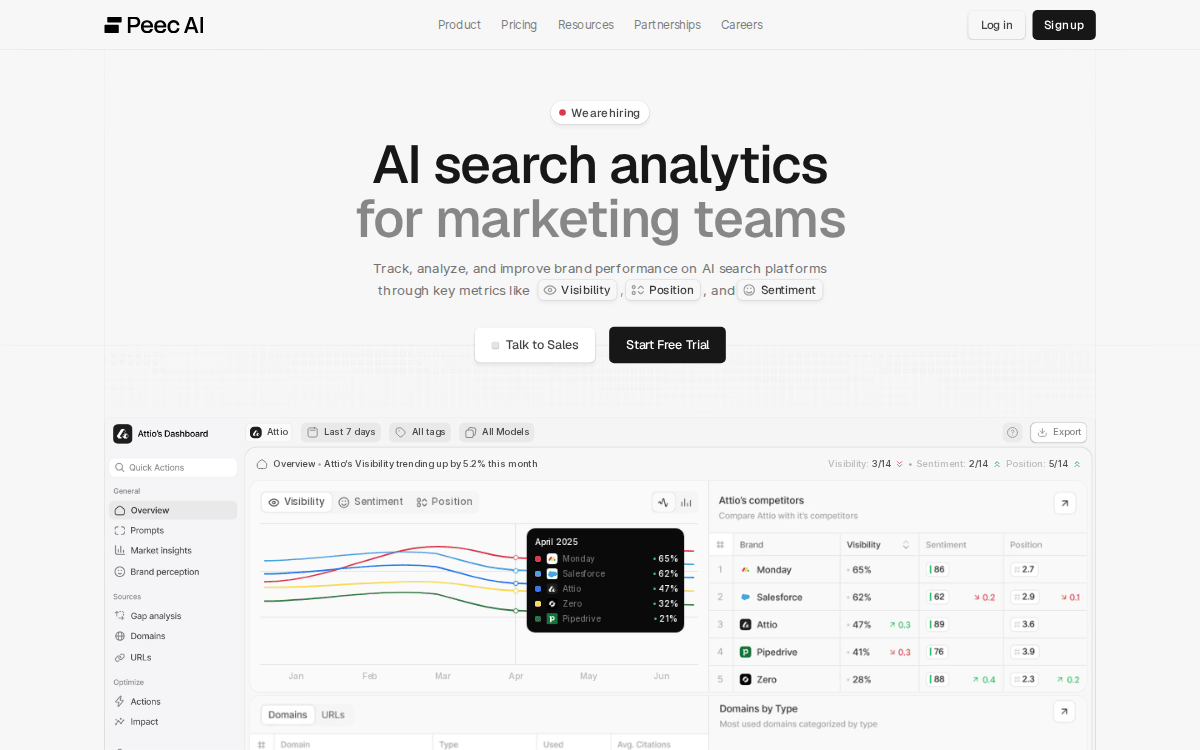
Peec AI is AI-search analytics for marketing teams: visibility, position and sentiment, tracked per country and market rather than as one global number. It names nine engines — ChatGPT, Google AI Overviews, Google AI Mode, Perplexity, Gemini, Claude, DeepSeek, Llama and Grok — and says it captures answers from the assistant’s interface rather than an API, so that results “mirror what actual users see” — the vendor’s claim, which we did not test. It also cites regional infrastructure across “80+ countries” (peec.ai, 15 Sep 2026). Unlimited seats on self-serve plans, a Looker Studio connector and an MCP integration.
- Pricing: Starter €89 / month (3 engines of your choice, 50 daily prompts), Pro €199, Enterprise from €499 (peec.ai/comparison/peec-vs-profound, 15 Sep 2026).
- Named in AI answers: 8 of 72 in our measurement of “recommend me a GEO AI agent for marketing” (23–28 Sep 2026).
Best for: agencies and brands running several markets or several brands.
Watch out for: three engines on Starter and Pro — more engines means Enterprise. It reports and recommends; applying the change is your team’s job.
4. Otterly.AI — the cheapest way in
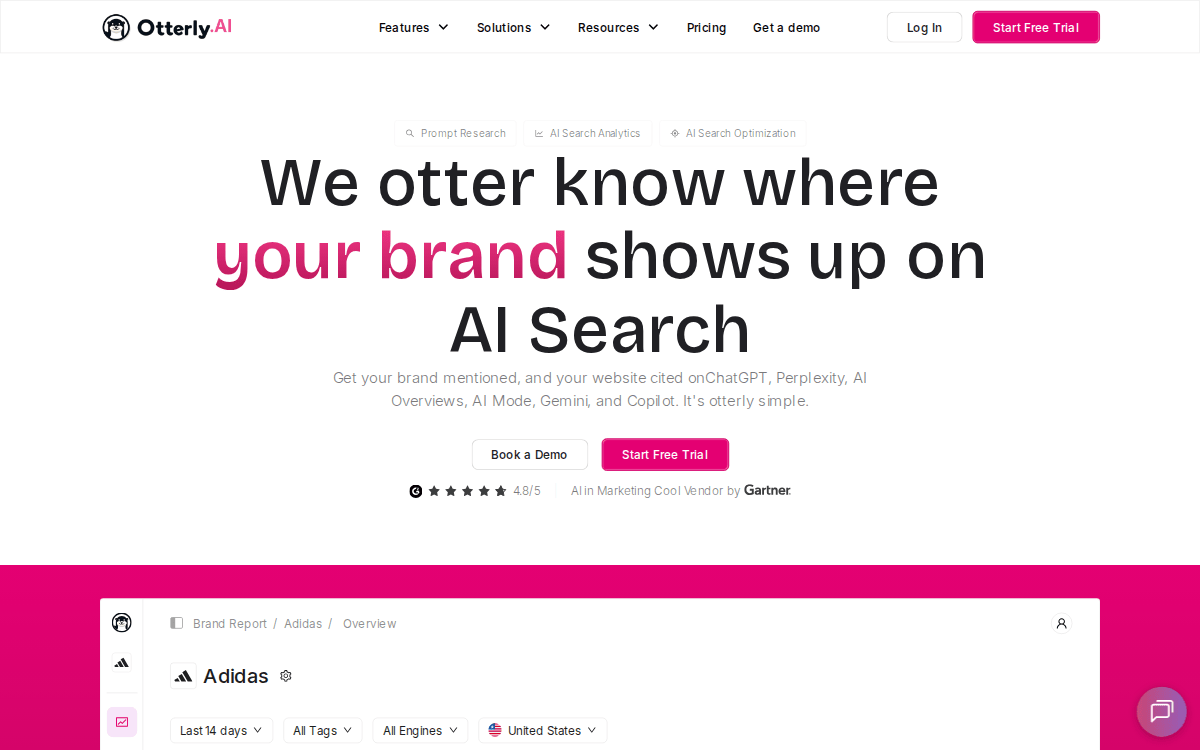
Otterly.AI monitors brand mentions and citations across ChatGPT, Perplexity, Google AI Overviews, AI Mode, Gemini and Copilot; the base plans track four engines, and Claude, Google AI Mode and Gemini are paid add-ons. On top of monitoring it now offers content audits, GEO recommendations and briefs, plus standalone GEO tools — keyword research, query fan-out, crawler simulation — usable without a paid plan.
- Pricing: Lite $29 / month (15 prompts, four engines); Standard $189 with API and MCP access; Premium $489; Enterprise from $1,000 (otterly.ai/pricing, 15 Sep 2026).
- Named in AI answers: 9 of 72 in our measurement of “recommend me a GEO AI agent for marketing” (23–28 Sep 2026).
Best for: solo marketers, consultants and small teams who want a periodic look at a few questions.
Watch out for: entry plans are small in prompts and engines; add-ons add up. Details in Scrunch, Otterly and alternatives.
5. Scrunch AI — the agent-experience layer
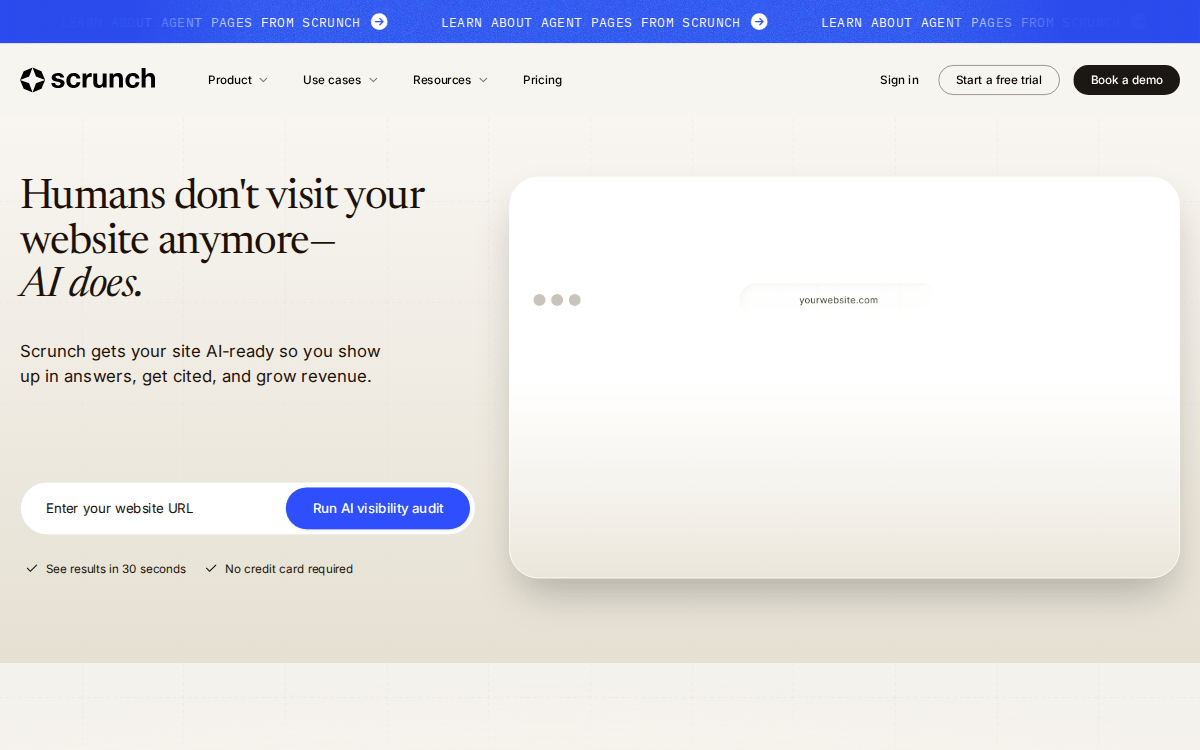
Scrunch AI monitors visibility across the main assistants and adds technical audits: bot activity, crawl health, errors and JavaScript rendering. Its distinctive piece is an agent-experience layer that serves a lightweight, machine-readable version of your site to crawlers and AI agents. It states SOC 2 Type II.
- Pricing: Starter $250 / month billed annually ($300 month-to-month, 7-day free trial), Growth $417 annually, Enterprise custom (scrunch.com/pricing, 15 Sep 2026).
- Named in AI answers: 2, both from Claude of 72 in our measurement of “recommend me a GEO AI agent for marketing” (23–28 Sep 2026).
Best for: enterprises and agencies with sites large enough for how machines read them to matter.
Watch out for: Sitecore acquired Scrunch in June 2026 — confirm roadmap and pricing continuity before a long contract.
6. AthenaHQ — the agentic copilot on your data
AthenaHQ tracks brand visibility, citations and sentiment across AI platforms and then recommends fixes. Its own angle is an agentic copilot trained on your account’s data rather than the open web, so you ask questions of your own numbers.
Best for: mid-market and enterprise teams with multi-brand or multi-location portfolios.
Watch out for: recommendations arrive for your team to apply; confirm current pricing and engine list in a demo.
7. AirOps — agents plus an execution team
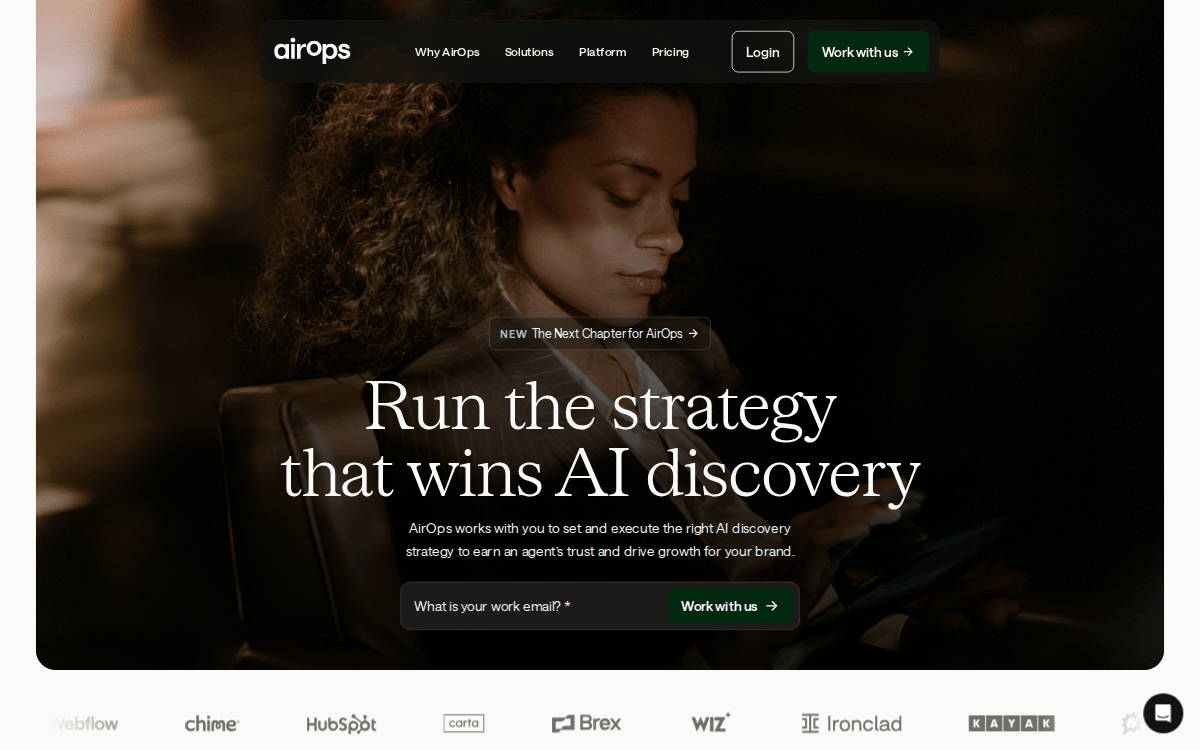
AirOps combines agents, content publishing and CMS integrations to run an AI-discovery strategy end to end. The software comes paired with a hands-on strategy and execution team, so it is closer to buying a content operation than a monitoring seat.
Best for: B2B SaaS and enterprise marketing teams that want execution capacity, not only software.
Watch out for: the product is content production at scale; if your gap is a fact missing on an existing page, a new article may not be the smallest fix.
8. Goodie — full-stack AEO, with shopping
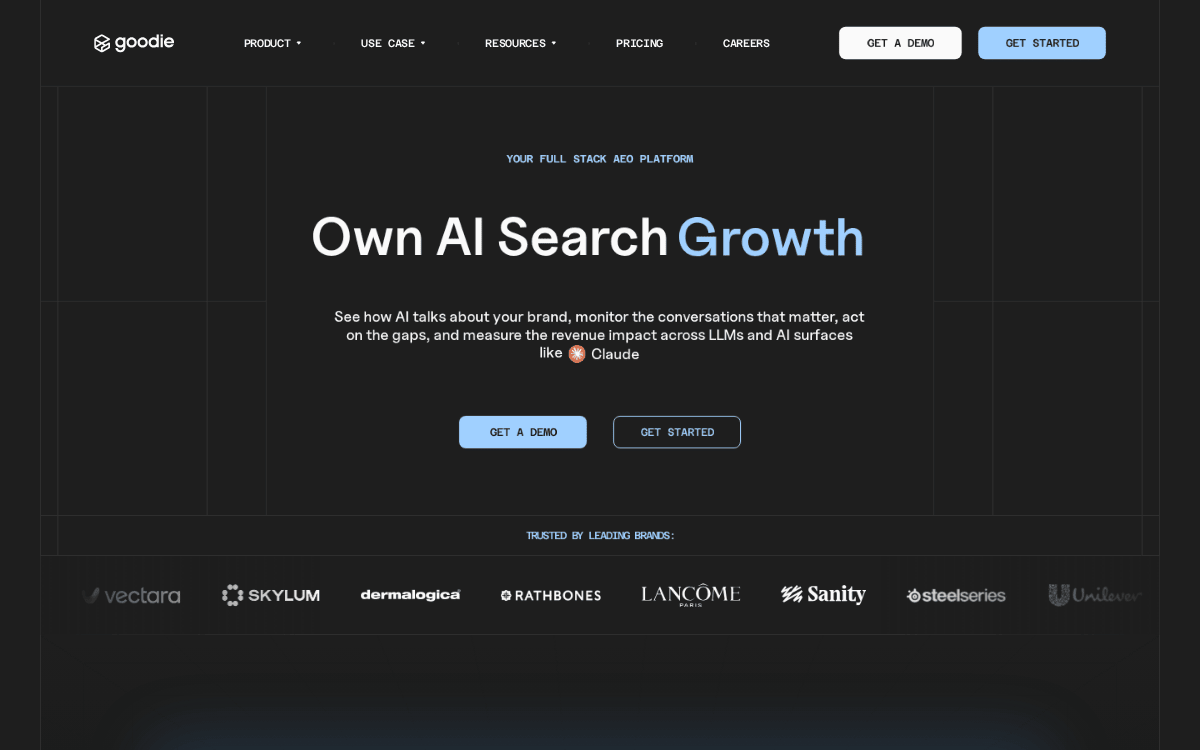
Goodie describes itself as a full-stack AEO platform built around a research → monitor → action → measure loop. Beyond brand mentions, it tracks products and SKUs for AI shopping agents.
Best for: enterprise and vertical brands — retail, SaaS, fintech, travel, healthcare — and their agencies.
Watch out for: ask what “action” means in practice: a recommendation, generated content, or a change to your own pages.
9. Semrush AI Toolkit — if you already live in Semrush
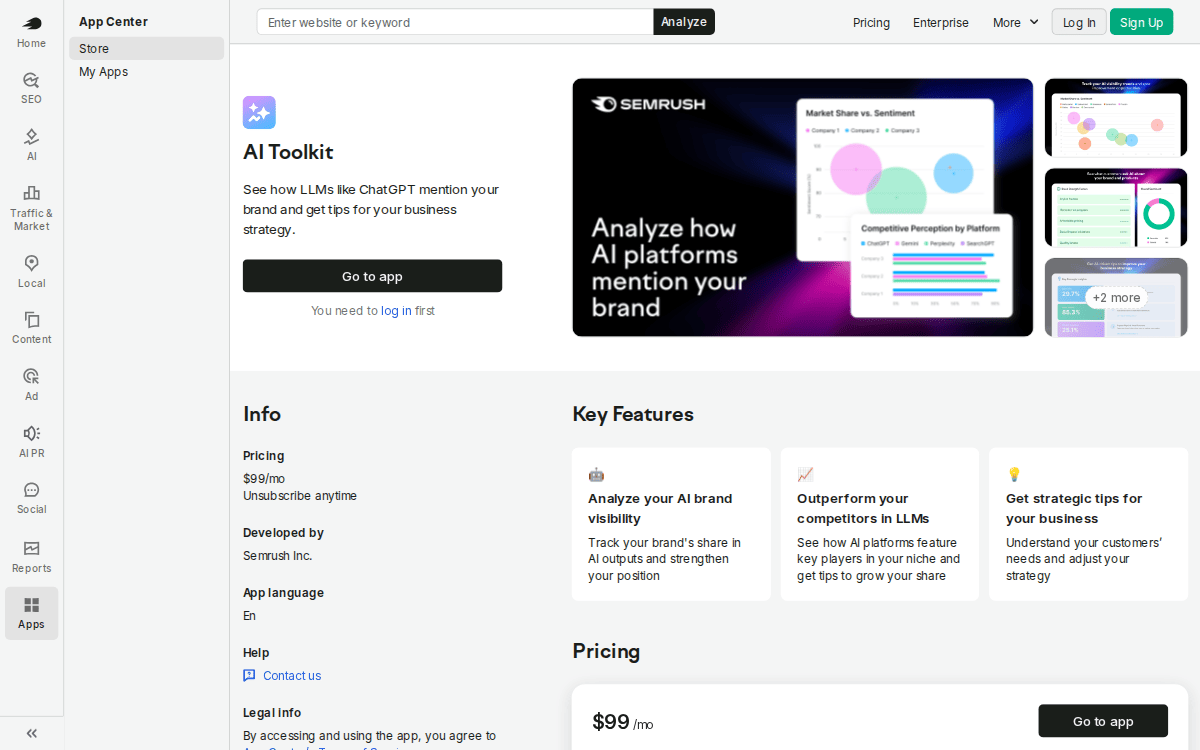
Semrush’s AI visibility toolkit tracks how a brand is mentioned and ranked across ChatGPT, Google AI, Gemini and Perplexity, updated daily, inside the suite you already use for competitor research, audits and reporting. Adobe completed its acquisition of Semrush in April 2026.
- Pricing: $99 / month as an app in the Semrush App Center (semrush.com/apps/ai-toolkit, 28 Sep 2026).
- Named in AI answers: 6 of 72 in our measurement of “recommend me a GEO AI agent for marketing” (23–28 Sep 2026).
Best for: teams already paying for Semrush who would rather not add a second vendor.
Watch out for: it is a module in an SEO suite — strong on reporting, stops at the recommendation.
10. SE Ranking — AI tracking for agency reporting
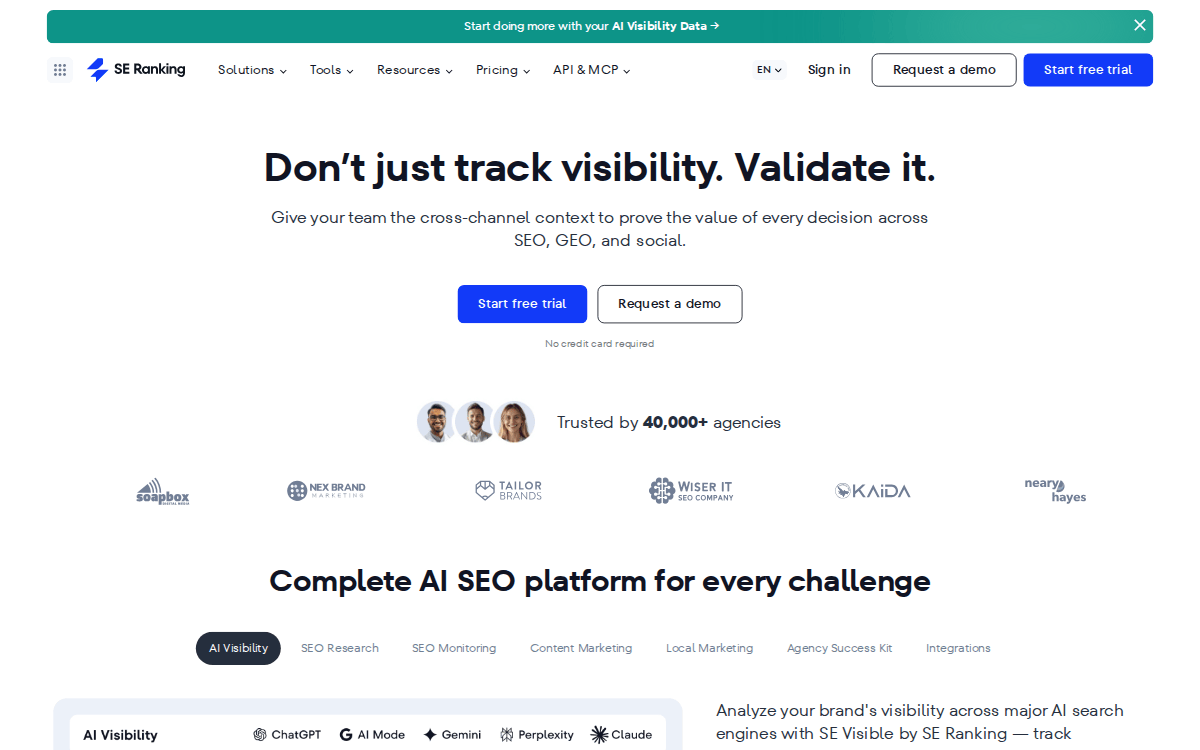
SE Ranking tracks brand mentions and citations across Google AI Overviews, AI Mode, ChatGPT, Gemini and Perplexity. It ships both in-suite AI trackers and a separate AI-visibility product, connecting AI visibility to rankings and competitor movement.
Best for: SEO and digital agencies doing competitive reporting for clients.
Watch out for: depth depends on which of the two products you buy — check before comparing on price.
11. Ahrefs Brand Radar — benchmarks without prompts
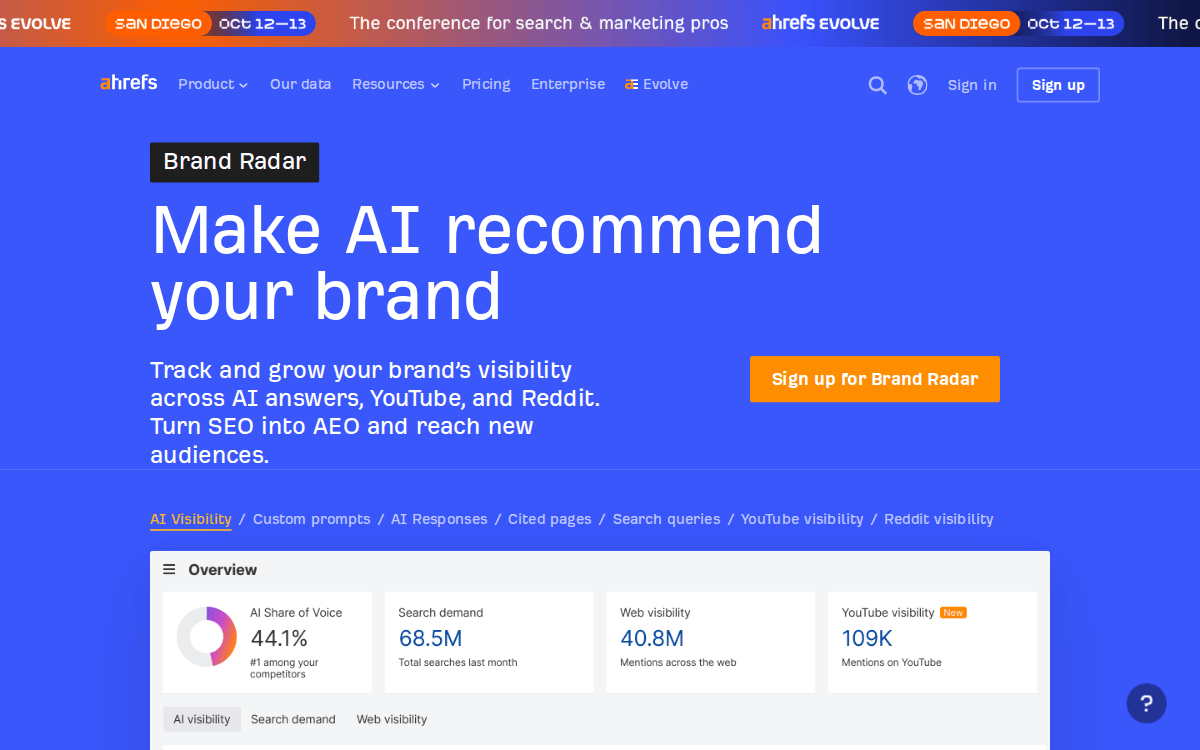
Brand Radar tracks mentions, citations and share of voice across ChatGPT, Gemini, Perplexity, Google AI Overviews and more, reading from an index of AI answers Ahrefs has already collected. You see numbers with nothing to configure.
Best for: established brands that want a category benchmark before building a prompt set.
Watch out for: it measures Ahrefs’ questions, not necessarily your buyers’ exact ones.
12. Evertune — measurement plus AI advertising
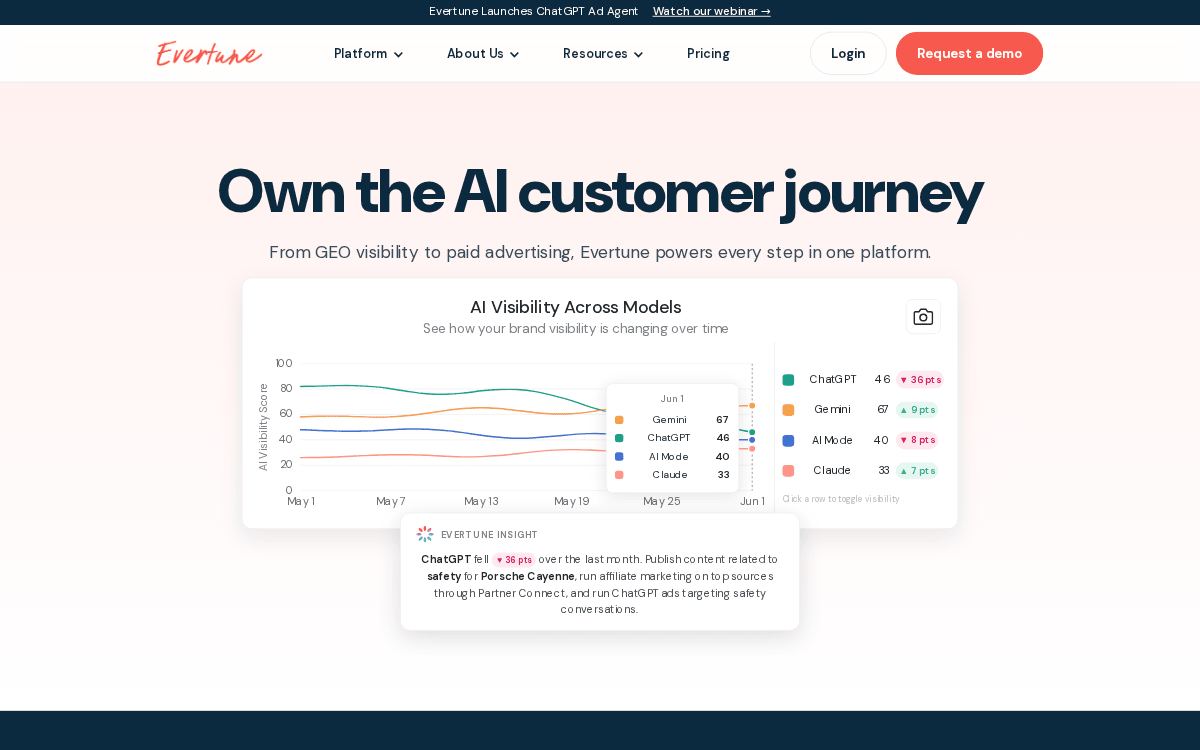
Evertune measures brand visibility across eleven AI models with unusually heavy sampling — each prompt run many times per model — and pairs it with generated articles and AI advertising, including ChatGPT ads.
Best for: advertisers and agencies running large consumer brands.
Watch out for: its answer to a gap is content and paid placement, not a reviewed change to your own pages.
Which GEO agents AI recommends today
If you ask an AI assistant to recommend a GEO agent, which names come back? We measured it with the CitePatch Monitor on the prompt “recomiéndame un agente geo ai para marketing” (“recommend me a GEO AI agent for marketing”), in Spanish, country Spain.
| Tool | Answers naming it (of 72) | Where it was named most |
|---|---|---|
| Profound | 19 | Copilot (7 of 12), Gemini (6 of 12) |
| Otterly.AI | 9 | Gemini (3 of 12) |
| Peec AI | 8 | Gemini (5 of 12) |
| Semrush | 6 | Gemini (3 of 12) |
| Scrunch AI | 2 | Claude (2 of 2) |
| CitePatch | 0 | — |
Source: CitePatch Monitor, 72 answers across ChatGPT, Gemini, Perplexity, Google AI Overviews, Google AI Mode, Copilot and Claude, 23–28 September 2026.
Three things stand out. No tool dominates: even Profound, the most-named, appears in about one answer in four. Engines disagree: Profound was named in 7 of 12 Copilot answers and none of Perplexity’s. Our own product is not named yet — the engines recommend the tools that already appear in the reviews, comparisons and lists they read, which is exactly the gap this page and CitePatch’s own loop are meant to close.
Limits. One prompt, one language and country, six days. Only brands tracked in the panel are counted, so other tools may appear without being counted; Claude contributed only 2 of the 72 answers. For a larger sample, see the generic question right below.
A larger sample: “best GEO tools”
With a more generic question and a longer window the split changes. We measured it with the CitePatch Monitor, in Spanish with country Spain, on the prompt “mejores herramientas GEO visibilidad IA” (best GEO tools for AI visibility).
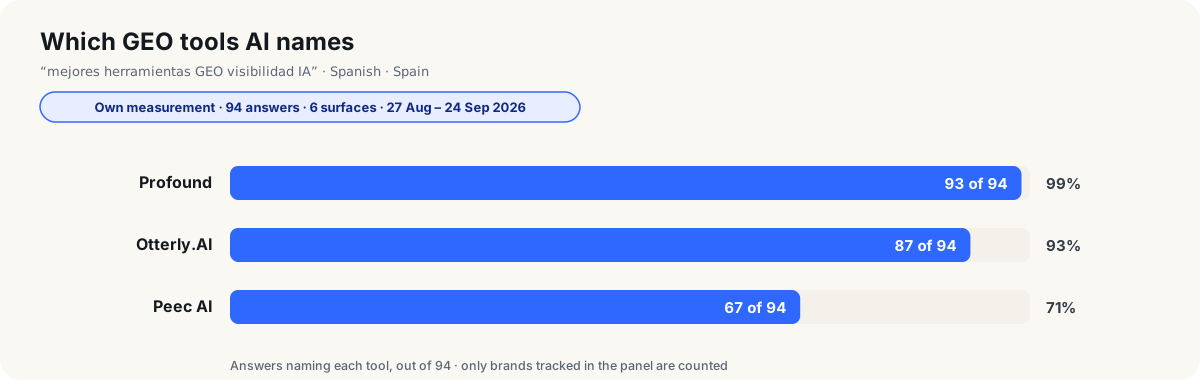
Three names dominate: Profound appears in 93 of 94 answers, Otterly.AI in 87 and Peec AI in 67. They are tools with a track record in the market and a presence in reviews, comparisons and third-party sites — exactly the material engines draw their answers from. CitePatch, the newer entrant, does not show up for this question yet.
The lesson holds for any category: AI tends to name whoever already appears in the sources it reads. So the first step is not writing more, it is knowing which pages the engines use as sources in your category and which of them leave you out.
How we measured it. Four Spanish-language category prompts, run on a schedule between 27 August and 24 September 2026 across ChatGPT, Google AI Mode, Google AI Overviews, Gemini, Perplexity and Copilot: 376 observations in total, 94 of them on the prompt in the chart. Two limits: only brands registered in the panel are counted, so other tools may appear without being counted; and it is a snapshot of one language, one country and four weeks.
Best GEO tool by use case
Best AI GEO tool for B2B SaaS
CitePatch, if your team ships its own site and has to prove what moved: it measures seven engines separately and opens the fix as a pull request or CMS draft. Profound if procurement needs SOC 2 and SSO first. AirOps if you want an execution team producing content for you.
Best AI GEO tool for agencies
Peec AI for unlimited seats and multi-brand, multi-country tracking; SE Ranking if client reporting already lives there. CitePatch Scale if clients pay for changes and proof, not only reports — each client connects their own CMS or repository.
Best AI GEO tool for ecommerce
CitePatch measures ChatGPT’s shopping carousel against your connected catalog on paid plans. Goodie tracks products and SKUs for AI shopping agents. Peec AI for the widest engine and country net.
Best AI GEO tool for enterprise
Profound and Scrunch AI — both publish SOC 2 — and Evertune for large consumer brands that also buy AI advertising.
Best cheap or free GEO tool
Otterly.AI Lite at $29 a month, plus free standalone GEO tools. CitePatch Starter has a 7-day free trial with no card, and the free audit needs no account.
Alternatives to Profound
If Profound’s custom Enterprise pricing is the blocker: Peec AI (published prices, nine engines), Otterly.AI (lowest entry price) and CitePatch (published prices, and a verified before and after on the same prompts). Full head-to-head in Peec AI vs Profound.
How to choose the right GEO tool or agent
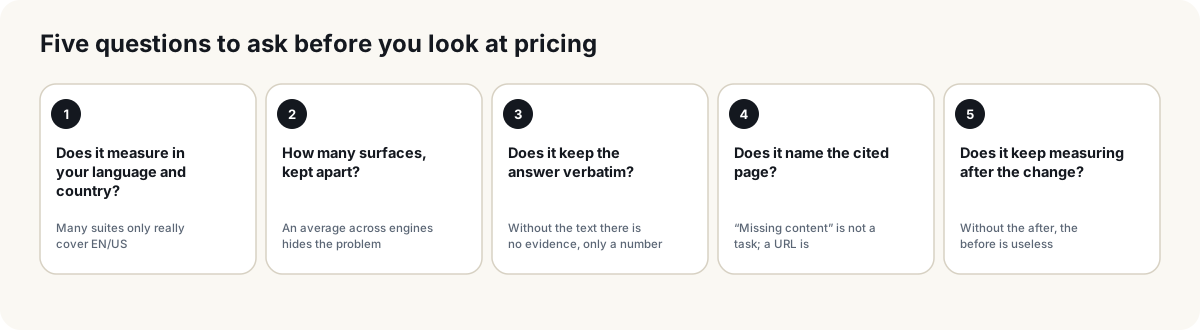
Five questions cut the list fastest: does it measure in your language and country; are engines kept apart; does it keep the answer verbatim; does it name the cited page; and does it keep measuring after the change? A tool that answers “no” to the last one leaves you with a before and no after.
When CitePatch is not the best choice
- You only need a weekly look at a few questions. Otterly.AI is cheaper.
- You need DeepSeek, Grok or Llama, or nine engines. Peec AI and Profound cover more.
- Procurement starts with a SOC 2 report. Profound and Scrunch publish one; CitePatch does not yet.
- You want a vendor to write and publish content at volume. AirOps sells that; CitePatch proposes bounded edits and a person takes the last click.
Next step
Shortlist two or three tools from the table, open their pricing pages and write today’s date next to what you see. Then run the free audit on your own domain: which engines already name you, and which pages they cite, will tell you more about which GEO tool or agent you need than any ranking — this one included.
Frequently asked questions
- What is the best AI GEO tool in 2026?
- It depends on what happens after the report. To only measure on a small budget, Otterly.AI or Peec AI. If you already pay for Semrush, SE Ranking or Ahrefs, switch on their AI module first. For enterprise governance, Profound or Scrunch. If every gap has to become a reviewed change on your page and be measured afterwards, CitePatch — which is why we rank it first, with its limits listed on this page.
- What is an AI GEO agent?
- A GEO tool that does more than report. A tracker tells you where AI answers leave you out; an agent also works the gap — it drafts content, proposes a change to a page or prepares it in your CMS or repository. The useful question is where the agent stops: at a draft, at a staged change, or at a verified before and after on the same prompts.
- What is the difference between a GEO tool and a GEO agent?
- A GEO tool measures: mentions, citations, share of voice and sentiment across AI engines. A GEO agent acts on that measurement. In 2026 the line is blurring — Profound, AthenaHQ, AirOps and CitePatch all describe agentic features — so compare what each one hands you at the end: a dashboard, a draft, or a change a person approved and the tool then re-measured.
- Which GEO agent does AI recommend most often?
- In our measurement of 72 answers to “recommend me a GEO AI agent for marketing” (Spanish, Spain, seven engines, 23–28 September 2026), Profound was named in 19, Otterly.AI in 9, Peec AI in 8, Semrush in 6 and Scrunch AI in 2. Engines disagreed: Profound appeared in 7 of 12 Copilot answers and in none from Perplexity. Only brands tracked in the panel were counted.
- How much do AI GEO tools cost?
- As of 15 September 2026, published entry prices run from $29 a month (Otterly.AI Lite) to €79 (CitePatch Starter) and €89 (Peec AI Starter). Scrunch publishes plans from $250 a month billed annually. Profound shows only a free trial and a custom-priced Enterprise tier, and several agent platforms sell on demo. Compare engines and prompts included, not the headline price.
- Which AI engines should a GEO tool cover?
- At least the ones your buyers use: usually ChatGPT, Google AI Overviews and AI Mode, Gemini and Perplexity, plus Copilot for B2B and Claude for technical audiences. More important than the count is that each engine is measured separately — one averaged score hides the engine where your problem is.
- Why does a GEO vendor rank itself first?
- Because it is our list and we would rather say so than hide it. Every price and claim about other tools carries its source and date, each tool gets a ‘watch out for’ line — CitePatch included — and the section on where CitePatch is not the best choice is on this page, not in the small print.
Evidence & sources
- CitePatch — tool-by-tool comparative with sources and review date (15 Sep 2026)
- Peec AI — published pricing (peec.ai/comparison/peec-vs-profound), fetched 15 Sep 2026
- Profound — pricing page (Trial and Enterprise only), fetched 15 Sep 2026
- Otterly.AI — pricing page, fetched 15 Sep 2026
- Scrunch AI — pricing page, fetched 15 Sep 2026
- Sitecore — press release on the acquisition of Scrunch (June 2026)
- Adobe — completion of the Semrush acquisition (April 2026)
- CitePatch — own measurement: 72 answers, 7 engines, 23–28 Sep 2026
- CitePatch — pricing
- CitePatch — security page (what is and is not in place)