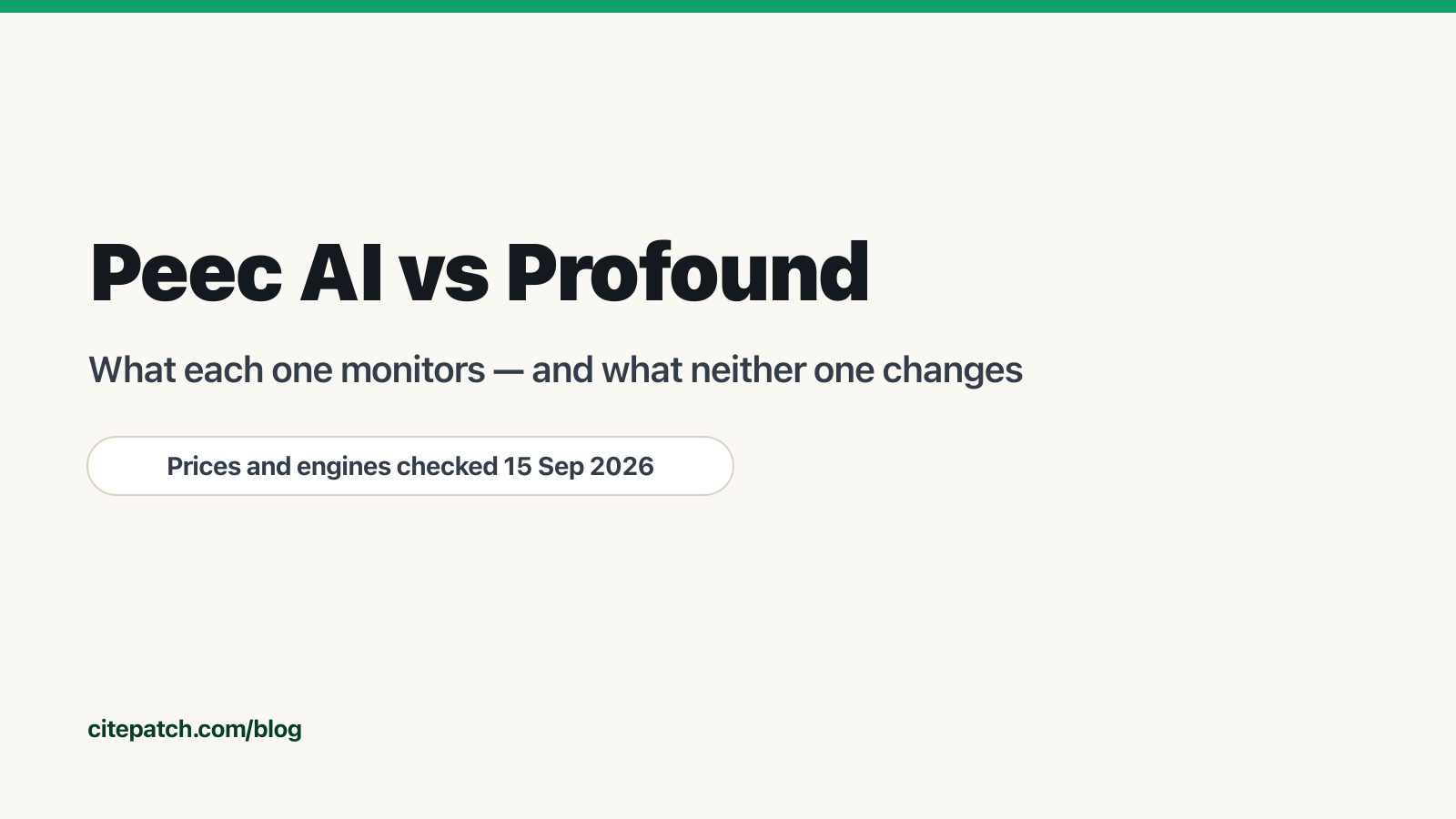
Peec AI vs Profound: what each one monitors, and what neither one changes
Two AI visibility trackers, one honest comparison. Engines, method, published prices and the team profile each one fits — plus the row where CitePatch sits, including where it loses.
If you are choosing between Peec AI and Profound, most of what you will find is written by one of the two. This page is written by a third party with an interest of its own: CitePatch sells a product in the adjacent category, so we have kept every claim sourced and dated, and given CitePatch’s weak spots the same space as its strong ones. Every price below was read from the vendor’s own public page on 15 September 2026 and will drift; the date is stamped inside each figure for that reason.
The quick verdict
Pick Peec AI if you want the widest engine list, the cheapest published entry price, regional coverage across many countries, and a tracker your whole team can log into without counting seats.
Pick Profound if you are an enterprise buyer who needs SOC 2, SSO/SAML, an API and a dedicated team, and you want the vendor that says it can draft and stage page rewrites in your CMS — accepting that its self-serve pricing is not published today.
Pick neither on its own if what you actually need is the answer to “did our change move the answers?”. Both stop at observation and recommendation; the verified change is a different row, and it is the one where CitePatch sits — with its own limits, listed below.
What each tool actually does
Engines and method
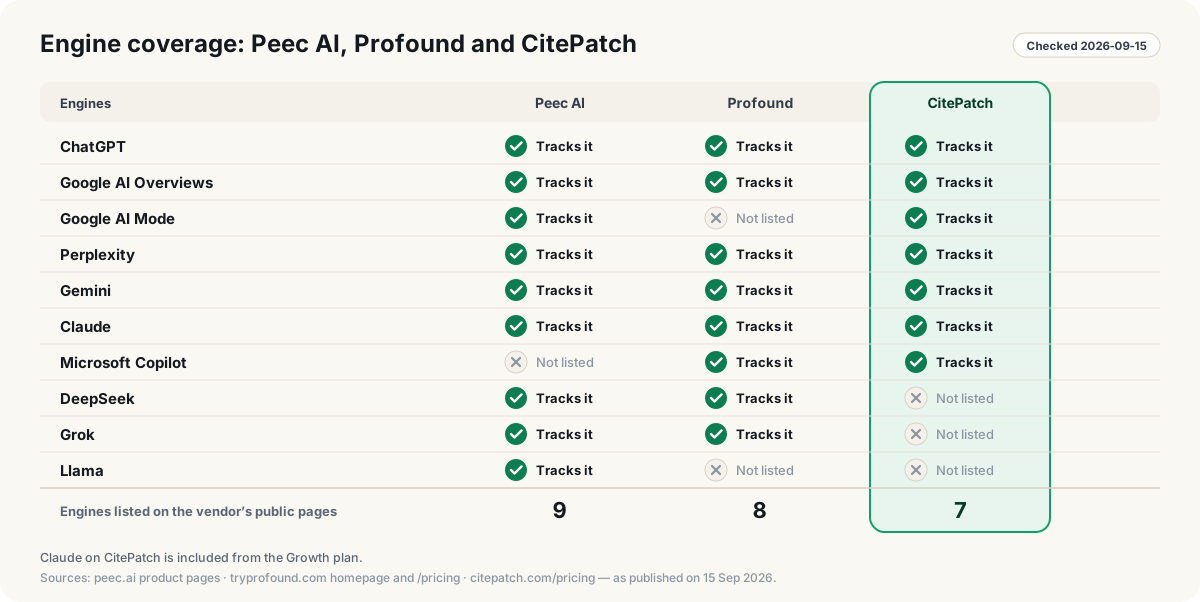
Peec AI names nine engines on its site: ChatGPT, Google AI Overviews, Google AI Mode, Perplexity, Gemini, Claude, DeepSeek, Llama and Grok (peec.ai, 15 Sep 2026). It states that it captures answers by scraping the assistant’s interface rather than calling an API, so that results “mirror what actual users see” — the vendor’s claim, which we did not test. It adds sentiment grouped by topic, multi-brand tracking, a Looker Studio connector and an MCP integration.
Profound’s homepage names eight platforms: Perplexity, ChatGPT, Claude, Gemini, Grok, Microsoft Copilot, DeepSeek and Google AI Overviews, and its Enterprise tier says “up to 9 Answer Engines” (tryprofound.com, 15 Sep 2026). It sells citation analytics — which sources are cited across answers — and, unlike Peec, its homepage claims it can “rewrite and republish website pages” and “stage edits before publishing” in your CMS.
Pricing, as published
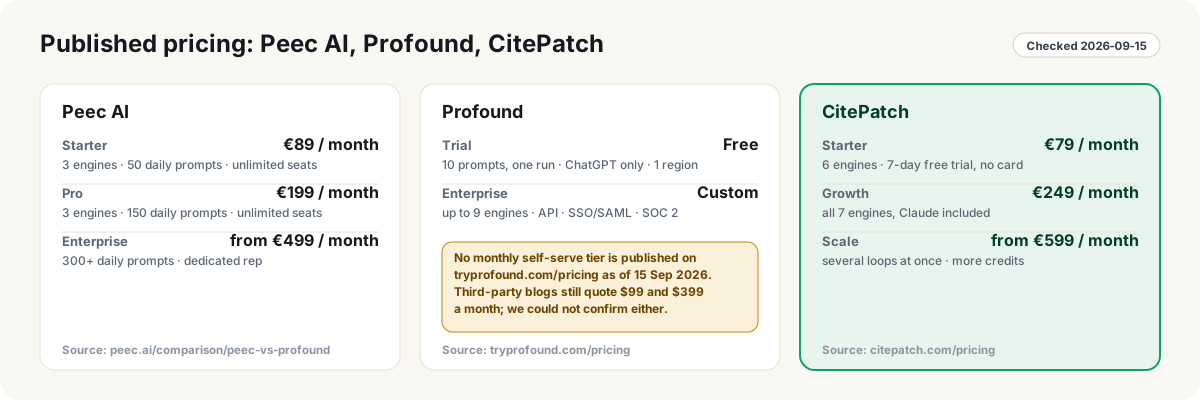
Peec AI’s pricing page renders its numbers client-side and only the tier names came through — Starter, Pro, Advanced, Enterprise (peec.ai/pricing, 15 Sep 2026). The figures below come from Peec’s own comparison page against Profound, which is first-party and on the same domain (peec.ai/comparison/peec-vs-profound, 15 Sep 2026). Third-party reviews quote slightly different USD figures; we use the EUR ones because they are Peec’s.
| Peec AI tier | Published price | What it lists |
|---|---|---|
| Starter | €89 / month | 3 AI engines of your choice, 50 daily tracked prompts, unlimited regions, unlimited seats, exports and optimisation recommendations |
| Pro | €199 / month | 150 daily tracked prompts, 3 engines, unlimited seats and countries, Slack support |
| Enterprise | from €499 / month | 300+ daily prompts, wider engine coverage, dedicated account rep |
Source: peec.ai/comparison/peec-vs-profound, 15 Sep 2026. A free trial and an annual discount are reported by third-party reviews only; we could not confirm either on Peec’s pages.
Profound’s pricing page shows exactly two tiers as of 15 September 2026: a free Trial and an Enterprise tier with custom pricing. We fetched it twice and asked specifically for the Starter and Growth tiers that circulate online; they are not there. Third-party blogs — including Peec’s own comparison page — still quote $99 a month for a Starter plan and $399 a month for a Growth plan. Treat those as possibly stale: they are not published on Profound’s pricing page today, and we do not estimate what a vendor has taken down.
| Profound tier | Published price | What it lists |
|---|---|---|
| Trial | Free | 10 unique prompts run once, ChatGPT only, 1 language and region, unlimited seats, no SSO |
| Enterprise | Custom | AI Marketer credits, custom prompt tracking, up to 9 answer engines, daily runs, CSV/JSON export and API, SSO/SAML, SOC 2 |
Source: tryprofound.com/pricing, 15 Sep 2026.
Where each one wins
Peec AI wins on breadth and on entry cost. Nine named engines against Profound’s eight and CitePatch’s seven. A published €89 Starter against a Profound page with no self-serve price and a CitePatch Starter at €79 that covers six engines. Regional infrastructure across “80+ countries”, per Peec’s site, which matters if your buyers ask in several markets. Unlimited seats on every self-serve tier, so an agency or a large marketing team does not pay per login.
Profound wins on the enterprise checklist and on ambition. SOC 2, SSO/SAML, an API with CSV and JSON export, dedicated support and a daily prompt frequency are all on its Enterprise tier. It is also the only one of the two whose homepage claims to go past recommending: rewriting pages and staging them in your CMS. If that claim holds in your stack, it removes a hand-off Peec leaves to you.
Neither wins on the question a tracker cannot answer: what the same prompts looked like before your change and after it. That needs the same prompts re-observed on a schedule, with a dated record from before the change to compare against. Nothing on either vendor’s public pages describes one.
Which to pick, by team profile
A marketing team of two to five, one brand, one or two markets. Peec AI’s Starter is the cheapest published way to watch three engines daily with the whole team logged in. You will hit the three-engine limit fast if your buyers use Copilot at work and Perplexity at home, and stepping up to Pro does not add engines, only prompts. Profound’s free Trial is a one-time run of ten prompts on ChatGPT — good for a demo, not for a decision. If you already know you will want to act on what you see, CitePatch Starter costs less per month than Peec Starter and covers six engines, but it is a younger product with a shorter track record; weigh that honestly.
An agency running several client brands. Peec’s unlimited seats and multi-brand tracking are built for this, and the Looker Studio connector fits client reporting. Profound’s Enterprise tier promises unlimited domains for agent analytics but you will be quoting a custom price to each client without a public anchor. CitePatch’s Scale plan is priced for running several loops at once, which is the agency shape, but each client’s patch still needs their CMS or repository connected and their own reviewer on the approval — that is more onboarding per client than a read-only tracker.
A B2B SaaS growth team that ships its own site. This is where the difference between “recommend” and “change” costs the most time. Peec will tell you which prompts you lose and suggest what to improve; someone on your team then writes the edit, opens the pull request and, in most companies, never goes back to check. Profound says it can write and stage the rewrite in your CMS; ask in the demo how the rewrite is bounded to facts you approved and how you will know it worked. CitePatch drafts the smallest edit that closes the gap, shows it as a plain before and after, opens a pull request or a draft in the system that owns the page, and keeps re-observing the same prompts on the Monitor’s own schedule, before and after. It also covers three fewer engines than Peec, which matters if DeepSeek or Grok is where your buyers are.
An enterprise with procurement, security review and an SSO mandate. Profound is the one of the two built for this conversation: SOC 2 and SSO/SAML are on its pricing page. Peec does not publish an equivalent enterprise security list. CitePatch does not publish any certification — its security page describes EU hosting, encryption in transit and at rest, scoped access, an audit log and self-service export and deletion. If your checklist starts with a SOC 2 report, CitePatch is not the answer today.
A consumer or ecommerce brand. Engine breadth and regional coverage weigh more here, and shopping answers are their own surface. Peec’s nine engines and 80+ countries are the widest net. CitePatch measures ChatGPT’s product carousel against a connected catalog on paid plans, which neither Peec nor Profound describes on its public pages — but it does that on fewer engines and in fewer markets.
What neither one closes
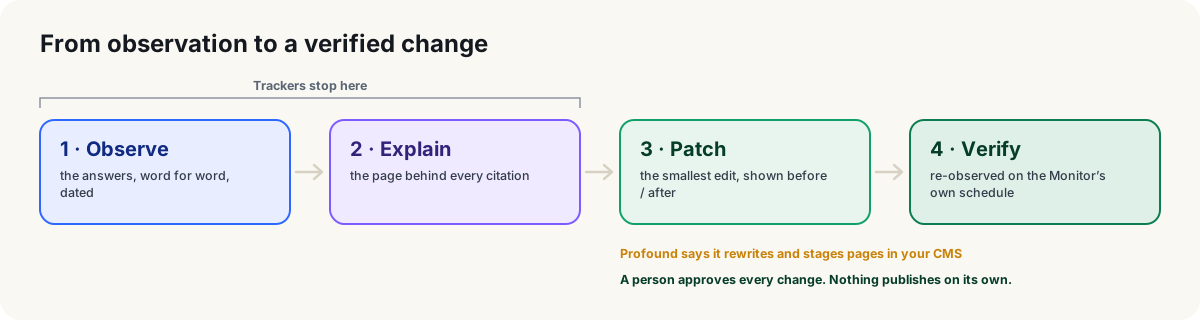
A tracker’s job ends when it shows you the gap. Peec AI does that across nine engines and adds recommendations. Profound does it across eight and says it can draft and stage the rewrite. What neither describes is the loop that turns an observation into a change you can defend: a bounded edit, drafted from facts you approved, reviewed by a person, prepared in the system that owns the page, and then kept in the Monitor’s own dated record, re-observed on the same prompts before and after — so you can read what the answer looked like before and after, not just assume it changed.
That is the row CitePatch occupies. It is also fair to write down where CitePatch loses against these two:
- Fewer engines. Seven — ChatGPT, Gemini, Perplexity, Claude, Copilot, Google AI Overviews and Google AI Mode — against Peec’s nine and Profound’s eight. No DeepSeek, no Grok, no Llama. Claude is included from the Growth plan, not on Starter.
- A younger product. Peec and Profound have public comparison pages, review-site listings and a body of third-party reviews. CitePatch does not have that track record yet.
- No claim of “billions of conversations.” Profound’s homepage claims analysis over billions of real user conversations; CitePatch measures only the prompts you approve.
- Profound already claims CMS republishing. If a vendor-drafted rewrite staged in your CMS is what you want, Profound says it does that today. CitePatch leaves a draft or opens a pull request for a person to finish; live publication is not enabled for any provider.
- No published certification. Profound lists SOC 2 and SSO/SAML. CitePatch does not publish any certification; its security page lists EU hosting, encryption, scoped access, an audit log and self-service export and deletion.
How CitePatch closes it
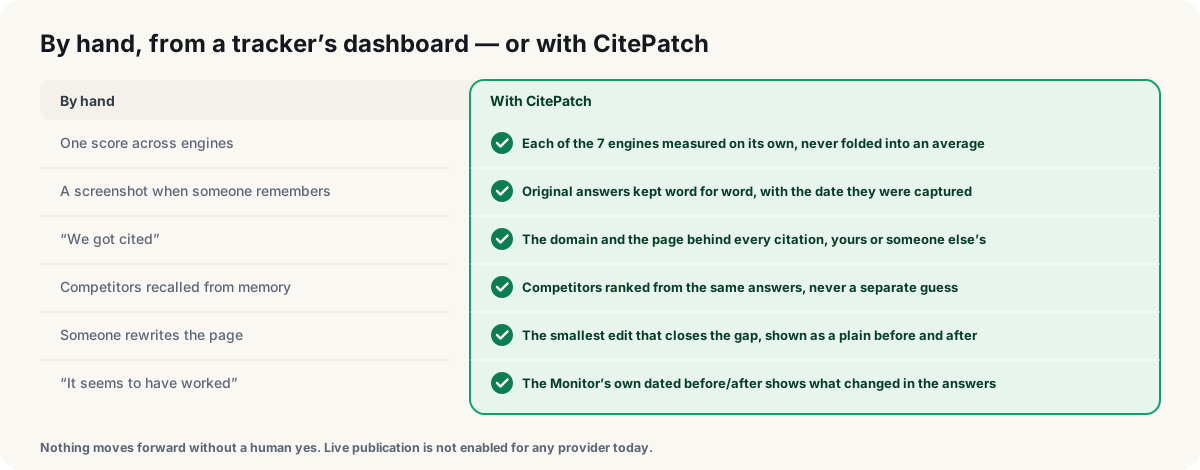
CitePatch watches how AI assistants answer your approved questions across the 7 engines, and keeps every original answer and every cited page open to inspection. The 7 engines your buyers use do not answer alike, and CitePatch never averages them into one: each is measured separately, and how every answer was captured is recorded beside it. An AI answer is built out of pages, so CitePatch names the domain and the page behind every citation, yours or someone else’s, and ranks competitors from the same answers, never a separate guess.
When a gap is yours to close, CitePatch drafts the smallest edit that closes it — precise, shown as a plain before and after, with no sweeping rewrites and no made-up claims — and prepares it where the page lives: a pull or merge request on GitHub, GitLab or Bitbucket, or a draft in WordPress, Shopify, Webflow, Wix or Contentful. Nothing moves forward without a human yes, and nothing is ever published automatically; a person takes the last click. Then the Monitor keeps re-observing how the assistants answer those questions, before your update and after, on its normal cadence — so you can read what changed, not assume it.
Next step
Open the three pricing pages linked at the end of this article and write today’s date next to what you see; then run the free audit on your own domain. Which engines already cite you, and which pages they cite, will tell you more about which tool to pick than any comparison written by a vendor — this one included.
Frequently asked questions
- Is Peec AI cheaper than Profound?
- At the entry level, yes, as far as anyone can tell from the public pages. Peec AI publishes a Starter plan at €89 a month on its own comparison page. Profound’s pricing page lists only a free Trial and an Enterprise tier with custom pricing as of 15 September 2026; the $99 and $399 monthly tiers that third-party blogs still quote are not on it, so we cannot confirm them.
- Which one tracks more AI engines?
- Peec AI names nine: ChatGPT, Google AI Overviews, Google AI Mode, Perplexity, Gemini, Claude, DeepSeek, Llama and Grok. Profound’s homepage names eight, adding Microsoft Copilot and leaving out Google AI Mode and Llama; its Enterprise tier says “up to 9 Answer Engines”. Each self-serve Peec tier picks a subset — three engines on Starter and Pro.
- Does either tool change my website?
- Peec AI reports and recommends; nothing on its public pages describes applying a change. Profound’s homepage says it can rewrite pages and stage them in your CMS. Neither describes keeping a dated before/after for the same prompts once a change ships, which is the record that shows whether the answers moved.
- Why is a competitor writing this comparison?
- Because the search results for it are written either by Peec, by Profound, or by content farms. We sell a product in the adjacent category, so every price here carries its source and its date, and the section on where CitePatch loses is as long as the one on where it wins.
Evidence & sources
- Peec AI — Peec vs Profound comparison page (pricing figures), fetched 15 Sep 2026
- Peec AI — pricing page (tier names), fetched 15 Sep 2026
- Peec AI — homepage (engines, regions, method), fetched 15 Sep 2026
- Profound — pricing page (Trial and Enterprise only), fetched 15 Sep 2026
- Profound — homepage (engines, CMS staging claim), fetched 15 Sep 2026
- CitePatch — pricing
- CitePatch — security page (what is and is not in place)